


At this time of the year, everything is beginning to grow, and it is a wise course of action to look at the support for all your climbing plants. If you want your roses to look like this in years to come, then they have to be tied in properly. This will encourage flowering.

They can be tied against wires (as above), trellis, mesh, or maybe you would prefer the natural effect of climbing plants growing through other shrubs or even trees.
Roses can be either climbers or ramblers. It is important to check the variety of rose that you are buying. The two types have different methods of annual maintenance. Ramblers have longer stems than climbers and flower on new wood, which means that any cutting back needs to be done in the Autumn.
The amount that is cut back is dependant on the variety, some will require more cutting back than others, again it is important to know what you have as both ramblers and climbers can be very vigorous and will quickly smother any support given, they can look spectacular but will need to be tied in to good strong support.
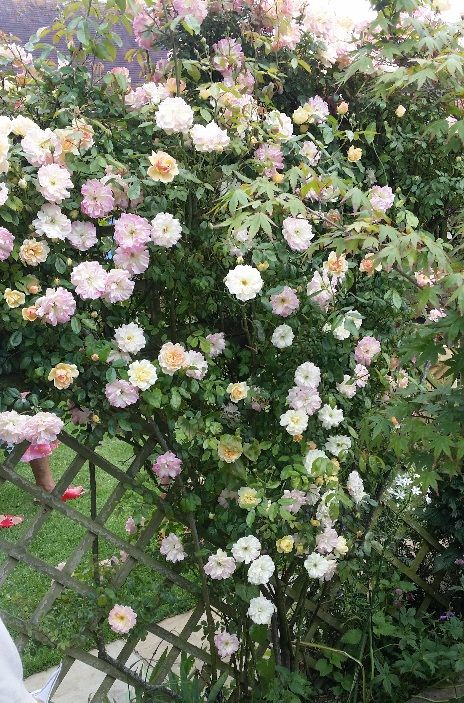
It must also not be forgotten that roses on the whole are deciduous. Therefore, the leaves and the flowers will fall, and this can create a lot of tidying work to do. I know this from experience, when years ago I planted a Madame Alfred Carriere against a shady North Wall. I was dreaming of the delicious scent and profusion of beautiful double flowers and did not appreciate the mess of the faded blooms as they fell, and being a repeat flowerer, it was all summer long. That was a good year, spectacular flowers followed by an unholy mess.
Ramblers usually flower once in profusion and often spectacularly, generally once and done sometime in June. whilst climbers generally repeat flower in measured amounts throughout the summer and their branches are stiffer.

A climbing rose will not need to be cut back very hard at all, just to keep any unwanted shoots within the area allotted to it and cut out any dead diseased or dying wood. Again, knowing what you have is important. When growing a climbing rose, try to make a framework of branches against the wall, trellis or fence.

When the side growths of this framework begin to grow, they will need to be tied into the framework. These will be the flowering shoots. Try to bend all the shoots horizontally as much as possible. This will force the buds to break and promote flowering.

But what if you have bought a house that has a rose already climbing its walls or fence.
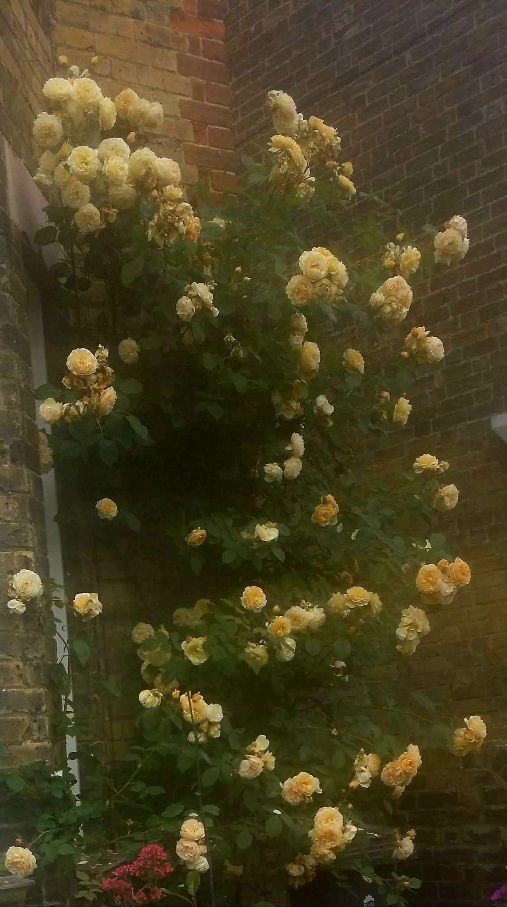
I would wait a year or so to check out the plant’s growth habit and then inspect the flowers to see if the plant can be identifed, whilst also checking the continuity of flowering as well. Is it a repeat flowerer or does it have one spectacular flowering in the summer. Does it have hips, does it have a scent, are the flowers single or multi petalled. There are a lot of things to consider before deciding how to maintain your inherited rose, and the internet can help with the identification process. Once you have an idea of which rose you have, then it is possible to decide how to maintain it.
As well as roses there are other shrubs that can be grown against a wall and used as wall shrubs, the Ribes (Flowering Currant) whose panicles of blooms hang down in shades of pink, red and white, in early spring.
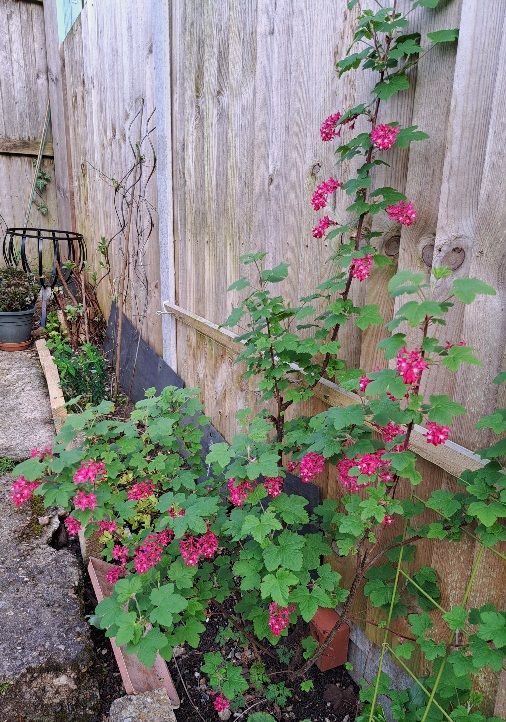
The Chaenomeles (flowering quince), which flowers in the very early spring, is a single blossom in shades of pink, red, and white. Ceanothus (californian lilac), which has either rich or sky blue panicles on small leaved shiny evergreen leaves, even apple and pear trees can be grown against a wall, they just have to be tied into supports.
Supports can be a variety of different types, wires and vine eyes, mesh with staples and mesh support clips that can be bought specifically for mesh, wooden trellis can also be purchased and fixed to a wooden fence with battens and screws, or even a galvanised metal mesh fixed to a fence or wall.

I am not sure I would fix any kind of trellis to a brick or stone wall, brick and stone can be very attractive in their own right and I feel it is best to use wire and vine eyes on these types of walls.

Last year I bought some plastic mesh and fixed it to my fence with staples, amid much cursing when the staples fell out. The mesh survived the winter but this year I am experimenting with mesh and mesh clips, they were not too difficult to fix to the fence, but I am not sure how secure they will be, I will keep an eye on them throughout the year. I have used an apple tree in the photograph below. which I am training against this plastic mesh.

I have since decided that I really don’t like plastic mesh for plants like this and will be replacing the mesh that supports this tree with wires and vine eyes. To me, that is what gardening is all about, experimentation and seeing what works best for you. On the other hand, I also have an everlasting sweet pea, which I have grown both with vine eyes and wires and also with the mesh. Last year, the plant looked much happier with the smaller guage mesh, where it could ramble around freely on the 6 ft space allotted to it.
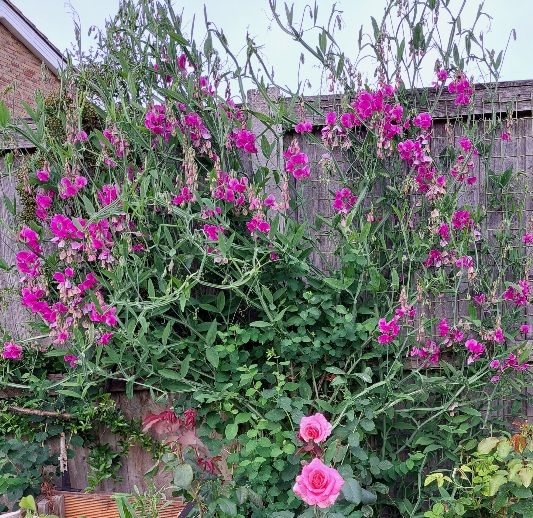
I have a feeling that this type of sprawling twining climber may look better on mesh support, whereas a climber or a trained tree with stiffer branches might look better with wires and vine eyes, growing over a pergola, walkway or up through an obelisk as here.

 Seeds and Seams
Leave a comment